Fast Food Line Tile Patterns: A Practical Design Resource for Creative Projects
Understanding Fast Food Line Tile Patterns
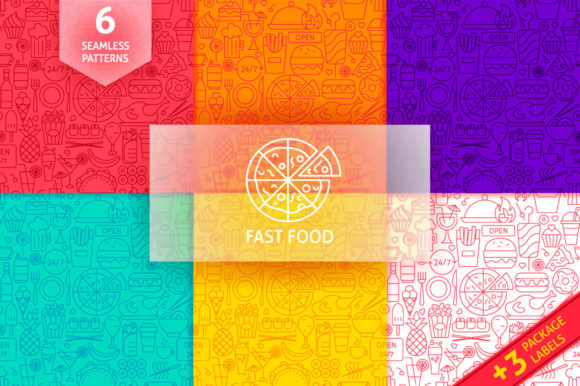
Fast Food Line Tile Patterns is a design bundle tailored for professionals seeking visually cohesive and adaptable assets for digital and print media. At its core, the collection includes six seamless tile patterns featuring minimalist line art of popular street food items. These patterns are designed to repeat without visible seams, making them ideal for backgrounds, textures, and decorative elements across various applications.
The bundle also includes three Fast Food Package Templates with logo placeholders and a Paper Template that adds a tactile dimension to food-related designs. All components are built with vector precision, ensuring scalability without quality loss, and are available in AI, EPS, SVG, and layered PSD formats. High-resolution raster files (PNG and JPG at 5000x5000 pixels) are provided for immediate use in web and print environments.
Design Quality and Technical Specifications
All vector files in the Fast Food Line Tile Patterns collection are fully editable, with closed paths and expanded strokes. This technical consistency ensures compatibility across design software, including Adobe Illustrator, Photoshop, and open-source tools like Inkscape. The use of thin line art gives the illustrations a modern, clean aesthetic that complements both minimal and vibrant design styles.
The inclusion of multiple file formats and resolutions makes this bundle versatile for different workflows. Vector formats allow for customization in branding and illustration projects, while high-resolution raster files are ready to use in web banners, posters, and social media graphics without additional preparation.
Usability Across Design Contexts
One of the key strengths of Fast Food Line Tile Patterns lies in its adaptability. The seamless nature of the tile patterns enables them to function as background textures in infographics, presentation slides, or website sections without disrupting readability or visual flow. Designers working on food blogs, restaurant apps, or promotional materials for street food festivals can integrate these patterns to add thematic consistency and visual interest.
The three package templates included are especially useful for product designers and brand developers. They offer a structured starting point for packaging mockups, allowing users to visualize how food products might appear in retail or delivery contexts. The paper template, meanwhile, supports print-based designs such as flyers, stickers, and takeout menus.
Who Benefits Most from This Bundle?
- Graphic designers looking for ready-to-use, scalable assets for food-themed projects
- Web developers integrating food-related visuals into responsive layouts or mobile apps
- Entrepreneurs launching food startups or delivery services needing cohesive branding elements
- Content creators producing food-related infographics, blog visuals, or social media templates
- Educators and publishers designing educational materials or children’s books with food motifs
These users benefit from the bundle’s flexibility, allowing them to repurpose the same assets across multiple platforms while maintaining visual harmony.
Practical Applications and Real-World Performance
In real-world use, the Fast Food Line Tile Patterns bundle performs well in both static and dynamic design environments. For example, a blogger covering street food culture might use the seamless patterns as background textures for article headers or infographic sidebars. The line art style maintains clarity at different scales, ensuring that visuals remain crisp on both desktop and mobile screens.
For a small business owner launching a new line of gourmet sauces, the package templates provide a professional framework for label mockups and packaging presentations. The vector format allows for easy color adjustments to align with brand palettes, while the layered PSD files enable quick editing in Photoshop-based workflows.
Strengths and Limitations
Key strengths of the Fast Food Line Tile Patterns include:
- High-quality vector illustrations with clean, modern line art
- Multiple file formats for broad compatibility
- Seamless tiling that works well in backgrounds and textures
- Well-organized PSD layers for efficient editing
- Scalable resolution suitable for print and digital use
However, potential limitations should also be considered:
- The minimalist style may not suit projects requiring photorealistic or detailed food imagery
- Customization requires basic vector editing knowledge
- Color variations are limited to black line art unless manually adjusted
Users who require a wide range of color options or more complex visual styles may need to supplement these assets with additional resources.
Recommendations for Use
For best results, Fast Food Line Tile Patterns should be integrated into projects where a clean, thematic visual style enhances the content without overpowering it. Designers can layer the patterns with solid colors or gradients to create depth while maintaining readability. The line art style pairs well with sans-serif typography, making it ideal for modern, minimal layouts.
When using the package templates, it’s recommended to test different logo placements and color schemes to ensure brand alignment. The paper template works especially well for print mockups, giving clients or internal teams a realistic preview of physical deliverables.
Long-Term Value and Conclusion
The Fast Food Line Tile Patterns bundle offers lasting value due to its high-quality vector construction and versatile format options. As design trends continue to favor minimalism and scalability, these assets remain relevant across multiple projects and industries. Whether used for digital interfaces, print media, or branding mockups, the collection provides a solid foundation for food-themed visual storytelling.
For professionals seeking efficient, reusable design elements that maintain technical and aesthetic integrity, Fast Food Line Tile Patterns is a practical, well-structured resource that supports both current and future creative needs.